


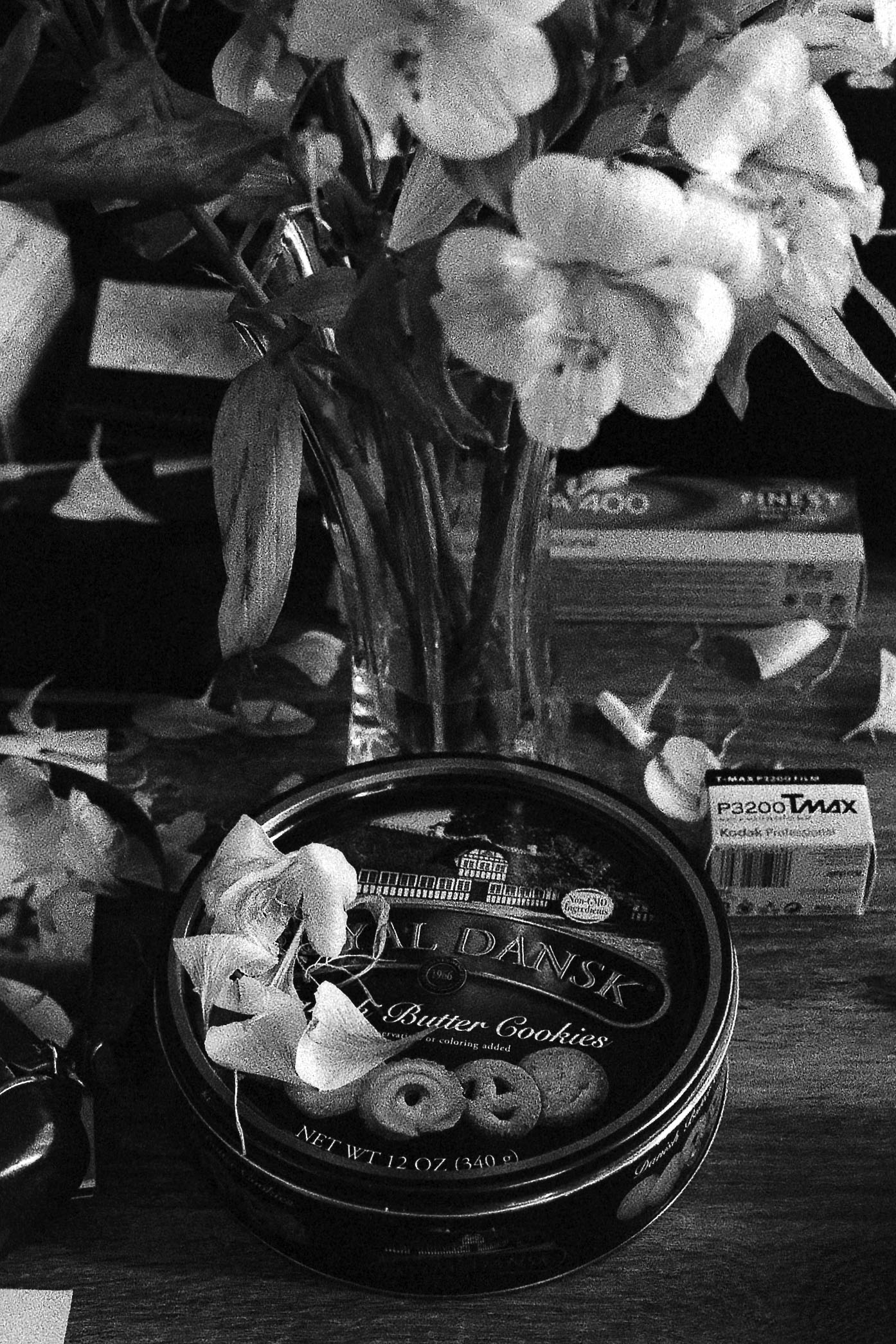
My quest to find a film that can be used in low lighting, everyday shots around the house is still on. I last reviewed pull processing Ilford Delta 3200 to 1600 to lower the contrast. I liked my results, but wasn’t crazy about the amount of grain in skin tones.
This week I decided to try out Kodak T-Max P3200. Here is the info Kodak Alaris provides:
KODAK PROFESSIONAL T-MAX P3200 Black & White Negative Film ⁄ 3200TMZ is a multi-speed continuous-tone panchromatic black-and-white negative film that combines high to ultra-high film speeds with finer grain than that of other fast black-and-white films. It is especially useful for very fast action; for dimly lighted scenes where you can’t use flash; for subjects that require good depth of field combined with fast shutter speeds; and for handholding telephoto lenses for fast action or in dim light. It is an excellent choice for nighttime photography.
It also says:
The nominal speed is EI 1000 when the film is processed in KODAK PROFESSIONAL T-MAX Developer or KODAK PROFESSIONAL T-MAX RS Developer and Replenisher, or EI 800 when it is processed in other KODAK black-and-white developers… Because of its great latitude, you can expose this film at EI 1600 and yield negatives of high quality.
I guess that means this film is basically an 800 ISO film but has the ability to be pushed to 3200. In that case, I’m not even really sure what I did is considered pulling.
I wanted to see how it stood up at 1600 ISO and compare it to the Ilford Delta 3200 results so I could narrow down my choices.
I shot one roll at 1600 ISO with my Nikon F, and then processed it at 1600. The second roll I shot at 1600 in my Fujica ST801 and processed at 3200. I processed both rolls in Kodak HC-110 dilution B, and I shot similar pictures around my home in the same lighting.

Nikon F 
Fujica ST801

As you can see above, shadows retain almost no detail. There is a warning that this may happen on the Kodak site. The grain in my opinion is worse than Ilford Delta 3200. Look at the blinds on the window. The grain is extremely visible.


Shot 1600 Dev at 3200 
Shot at 1600 Dev. at 1600
I think the roll pulled to 1600 in processing has a little bit less grain than the roll (on the left) shot at 1600 and processed at 3200. It also has a little more sharpness than the roll processed at 3200.

I also read in my research that scanning this film seems to enhance the grain. I do know I need a film that will respond well to being scanned on a flatbed scanner.

Ilford Delta 3200 
P3200 shot @ 1600 developed @ 3200


You can see above that Delta 3200 pulled to 1600 has less contrast than P3200, but also significantly less grain. It has a softer look to it. Kodak states that this is an ultra fine grain film, but that is just not the experience I have ever had with it.
Final Thoughts
I definitely think I choose Ilford Delta 3200 over the Kodak P3200. I just really do not like this film. I think the leader in my quest will remain for now Ilford Delta 3200 pulled to 1600. I may try shooting P3200 at ISO 800 one day and see how it looks, but that doesn’t help my needs.
What film should I try next in my quest for a film to shoot around the house handheld? Let me know in the comments.
Until next time, stay motivated and keep shooting.