

Joel Meyerowitz believed that setting boundaries could shape the way you see. One of the simplest ways to do that, he suggested, is to choose a single focal length—and stick with it.
It’s a simple idea, but one I had never fully committed to. So this year, I decided to test it for myself.
In this series, I’m choosing one focal length at a time and spending time with it—paying attention not just to the images I make, but to how it changes the way I see. Along the way, I’ll also be sharing my thoughts on the lenses I use and what I learn from each one.
I’m starting with 35mm—and with a lens that has quietly shaped much of my photography over the years: the Voigtländer Nokton Classic 35mm f/1.4 II. Let’s get into it.
*There are affiliate links in this article. Purchasing through these links supports my work with no additional cost to your purchase. It’s greatly appreciated. Also, don’t forget to watch the video at the very bottom for even more info.
Why Limitation Helps You Find Your Style
Joel Meyerowitz believed that photography is, at its core, a way of discovering who you are. The images you’re drawn to make—whether you realize it or not—start to reveal what you find meaningful. Over time, that becomes your style.
One of the ways he explored this was by setting boundaries for himself. He would often limit his process—sometimes by sticking to a single focal length, other times by working with a fixed shutter speed. These constraints weren’t restrictive; they forced him to think more carefully about every decision he made.
And in that process, he began to understand himself more clearly.
This way of working is simple in theory: set a boundary, create within it, and then reflect on the results. Pay attention to the patterns that emerge—what you choose to include, what you leave out, and what you find yourself returning to without even realizing it.
Meyerowitz noticed, over time, that he was repeatedly drawn to photographing flowers. It wasn’t something he set out to do—it revealed itself through the work. That observation eventually led up to his book Flowers
What you notice will reflect the way the world speaks to you, and only you.” – J.M.
What 35mm Revealed About My Photography
When I first started out in photography, I almost always shot with a 50mm lens. It was what came with most of my cameras, and it was often described as the focal length closest to the human eye. At the time, I didn’t question it—I wasn’t really thinking about lenses at all. But over time, something started to feel off.

I began to notice that I was missing moments—not because I wasn’t there, but because I couldn’t include everything I wanted within the frame. That realization didn’t fully click until I picked up a 35mm lens.
Around the same time, I came across an idea that stuck with me: photography is less about what you add, and more about what you choose to leave out. That shifted the way I thought about composition. I didn’t just want to capture a subject anymore—I wanted control over the story surrounding it.

Voigtlander 35mm f1.4
Moving to 35mm gave me that.
Instead of isolating a subject, I found myself drawn to including more of the environment—letting the surroundings become part of the image. Over time, I started to notice patterns in my work. A friend once described my photos as romantic, while another said they felt lonely.

I hadn’t set out to create that feeling—but it was there.
With 35mm, I’ve started to understand how I use space more intuitively. The extra room in the frame isn’t just background—it’s where I begin to express things I didn’t even realize I was trying to say. Grief, loneliness, and the quiet beauty of light all seem to find their way into my images.

And I think that might be the beginning of my point of view.
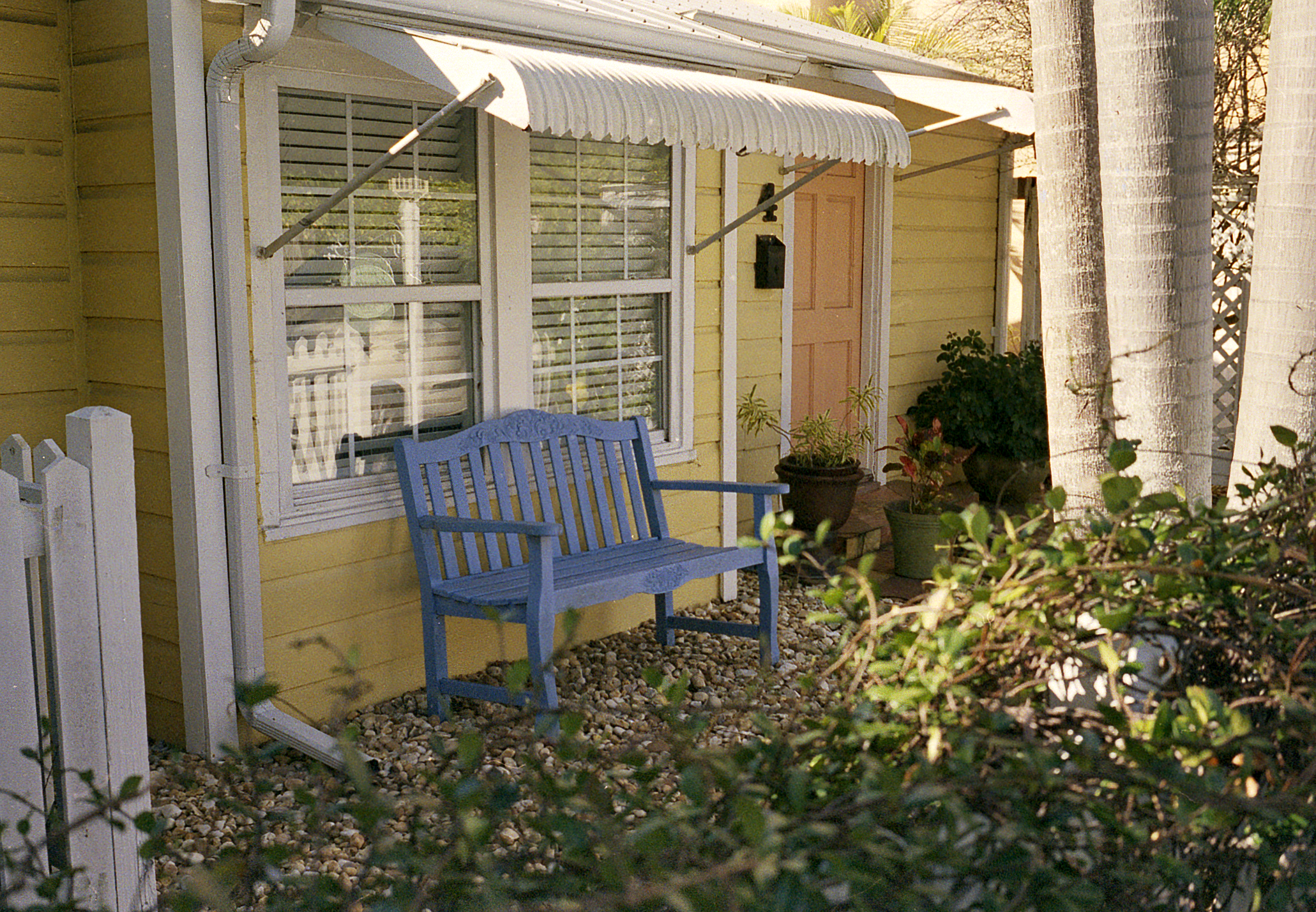

Kodak Portra 800


Why the Voigtlander Nokton Classic 35mm f1.4?
I bought this lens almost six years ago for my Leica M2. As I mentioned in a previous article, the M2 is my family camera—I’ve used it to record countless special moments, and this lens has been the eye through which I’ve captured them. It recorded my wife’s pregnancy, our daughter’s birth, and the small, everyday moments that make up our lives. Over time, it became my most used lens and now the starting point for this series

When I first chose the Voigtlander 35mm f/1.4, practicality played a big role. It was far more affordable than Leica glass, though I eventually added a Summicron 35mm lens to my kit—more on that in another article. Beyond cost, I needed that extra stop of light for shooting inside our dimly lit home. That decision proved invaluable; I’ve used this lens wide open more times than I can count, capturing soft, intimate images that would have been impossible otherwise.
Please take a moment to sign up for my articles in your inbox!
After six years of heavy use, I can confidently share what makes this lens special—and where it really shines in everyday photography.

Is the Voigtlander 35mm f1.4 a Good Lens?
The answer to whether the Voigtlander 35mm f/1.4 is a good lens is, of course, subjective—but here’s my take.
Ergonomically, it’s a joy to use. The aperture ring is smooth and clicks precisely when it should, and I love the two grips on opposite sides that let me adjust the aperture without even looking—a feature I wish more lenses had. The focusing lever moves just as smoothly, working perfectly with the aperture ring to make shooting effortless and intuitive.

Despite its lower price, the lens feels solid and well-made. Its high-quality metal construction includes an aluminum barrel, brass focusing helicoids, and a chrome-plated brass mount. It’s compact and lightweight, though the lens hood can make it a bit bulky when storing it in a bag. Without the hood, it has a slim, unobtrusive profile that’s easy to carry all day.


The Character of the Nokton Classic
Voigtlander designed this lens to capture the style and character of lenses from the 1960s and ’70s—that’s where the “Classic” name comes from. While the Nokton 35mm f/1.4 is still fairly young, it carries a personality all its own.
The Nokton part of its name refers to the fast f/1.4 aperture. It gives the lens its signature low-light performance, and wide open it can vignette slightly—especially indoors. For me, these small imperfections are part of the appeal. I want the lens to have character; otherwise, images can feel too sterile.

Voigtlander 35mm f1.4


The bokeh is, for lack of a better word, a bit messy. It swirls subtly toward the edges and doesn’t have any flashy artifacts—but that’s exactly what I like about it. It adds texture and depth without distracting from the subject. I’ve shot both with and without the lens hood and have never noticed significant flare, which makes it a reliable companion in almost any situation.

Final Thoughts
This whole project began after reading Joel’s advice while studying his photo-books. I’ve been exploring my style and vision as a photographer for a while, and this experiment feels like a step in that direction.


Kodak Portra 800
Sticking to a single focal length for a month is a boundary I’ve set for myself to challenge my creativity. So far, it’s been a lot of fun, and I’m excited to see what I’ll discover with other lenses in the series. If you’d like to join me on this journey, I’d love to hear from you—share your thoughts in the comments or send me a message. Do you have a lens that defines your vision?


Until next time, stay motivated and keep shooting.
If you enjoyed this article and would like to contribute, please click the button below. Either way, thank you so much for reading.
If you’d like to buy a Voigtlander Nokton Classic 35mm f1.4 lens to try for yourself, you can pick one up on B&H, KEH, or eBay.
The Joel Meyerowitz books I quoted from in this article:
How I Make Photographs
Where I Find Myself
Europa 1966-1967
To Shop for 35mm format film camera on KEH –CLICK HERE
Shop for 35mm format film camera on Ebay – CLICK HERE
To buy color film CLICK HERE.
OR B&W Film CLICK HERE.
To Shop for Medium Format film camera on KEH – CLICK HERE
Shop for Medium Format film camera on Ebay – CLICK HERE
These are affiliate links to KEH Camera, Ebay, and Amazon. Simply purchasing through these links, you’re supporting my work with no additional cost to your
I am not Anonymous, don’t know what I did wrong! D’oh!
Haha I’m glad you told me. I always wonder who the anonymous people are.
Growing up in my parents’ little commercial studio, the only wide lens we had for our Nikons and Nikkormats was a 1968-vintage Nikkor 28/3.5. When I was away at college, they got a vintage-1972 Nikkor 35/2. A few years later when I had a summer job making a slide show about a county summer youth employment program, I borrowed one of the studio’s Nikons and that lens (and a little Gossen selenium light meter, there was just a plain prism head on the Nikon). And I totally fell in love with the 35’s angle of view that summer!
When I got my first Olympus OM camera a couple of years later (an OM-G; these days I shoot with an OM-1n and OM-2n), I got the standard 50/1.8 lens as part of the kit, but I pushed my finances to also get a Zuiko 35/2. In the 40+ years since, I have basically NEVER mounted the 50mm lens, because I love using the 35/2 as my normal lens. (If I go out shooting with multiple primes – I have never owned a zoom – it’s often with that one or the 24/2.8, plus the awesome 100/2.8.)
For the record, I still have my parents’ Nikkor lenses – 28/3.5, 35/2, 45/2.8 GN, 50/1.4, 105/2.5 – and they’ve all been used on my F2 and Nikkormat in recent years. Some of these lenses are 60 years old, and they had long use, then long disuse… yet none has ever required a CLA! The build quality of these metal pre-AI Nikkors must be experienced in person, and they are amazing bargains in the current market.
But you know, the 35/2 isn’t the Nikkor lens I use the most, that’s the astounding 45/2.8 GN. It’s less than HALF the size/weight of the others and crazy sharp, plus it stops all the way down to f/32.
This unique lens was designed to work with full-power manual flashes before the introduction of automatic flashes. You’d lock the aperture and focus rings together based on the flash’s Guide Number, and it would automatically close the aperture as you focus closer and open it as you focus further. I used it this way a few times, and I can testify that this method worked spectacularly well… But self-quenching automatic flashes like the Vivitar 283 appeared just a couple of years later, rendering this lens unnecessary for its original function. But it was and remains a GREAT “pancake lens”!
Thanks for sharing that! I have an Olympus OMG that my Uncle sent me. I have not gotten the chance to use it yet.
I’m a huge fan of the Pre-ai Nikkor lenses. I have many of them and the Nikon F system is my favorite 35mm camera system so far.
I love my 60s/70s Nikon gear, but in recent years I’ve been using my OMs and Pen half-frames a bit more frequently, just because they’re easier to carry.
Both the Nikkor and Zuiko lenses create uniquely different images with their 60s and 70s, designed by human beings (not computers) construction. And while the OM gear doesn’t have the survive-an-atomic-bomb build quality of the early Nikon stuff, it’s plenty solid while being lighter/smaller. OM cameras are a huge pleasure to shoot! I’m curious to hear how you like the OM-G when you get around to trying it.
I don’t use my OM-G anymore, I moved up to more solid and elegant, pro-quality OM-1n and OM-2n bodies long ago. The last time I checked it, my OM-G’s light meter and auto mode didn’t work… but oddly enough, its manual shutter speeds seemed okay. I should probably just give it away to some aspiring Gen Z film shooter… (Email me if you’re interested!)
I hear great things about the OM system all the time. I need to get the OMG out and test it. My health just keeps knocking me back down. So frustrating.
I must admit that my happy place is using any of my Olympus OM cameras and my Zuiko 28mm f/3.5. I can get more of the wonderful building we have here in my photos and, despite the lens being “slow”, it is far from being naff. I have “better” Zuiko lenses, but that Zuiko 28mm f/3.5 hits the spot every time, especially in our older towns and cities here in the UK where the back streets are narrow and you have to go for the wide angle prime.
28 is perfect for that situation. I haven’t tried an OM camera before. My uncle sent me an OMG perfect name for our times LOL but I haven’t used it yet. Thanks for sharing your experience!
Aly: Thanks for the reminders about composition. So true. I was pleased to see that image of you in the rear view mirror. Love it.
Thank you!